PANDA experiment

PANDA (AntiProton Annihilations at Darmstadt) worldwide collaboration of scientists, proposed in 2004  to build a “state of the art” multi-purpose detector for strong interaction studies, at the high-energy storage ring HESR at the international FAIR facility. The physics program to be covered includes many aspects of strong interactions at energies from a few GeV to a few tens of GeV (QCD bound states, Non-perturbative QCD Dynamics, Hypernuclear Physics, Nucleon Structure, Electroweak decays of rare D mesons). To accomplish its ample physics program,  PANDA Collaboration should build (Fig. 1) a general purpose detector  which has to achieve near 4pi acceptance, high resolution for tracking, particle identification and calorimetry, high rate capabilities and a versatile readout and event selection.
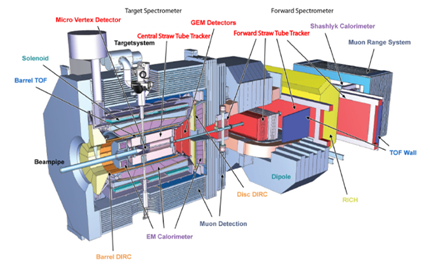
The approved PANDA design

SISTINA project

Since the PANDA experiment is under the construction phase, the activities of the IFIN-HH team during the project are focused on :
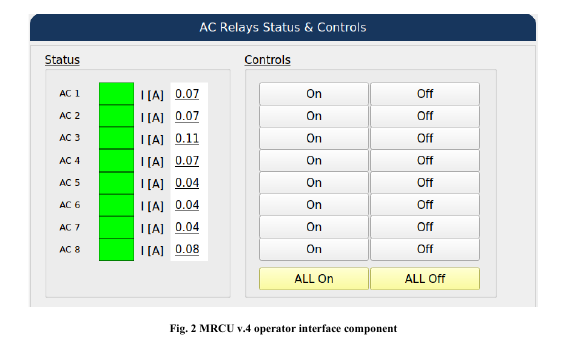
- The integration of the new version of Multipurpose Rack Control Unit device in the control system;
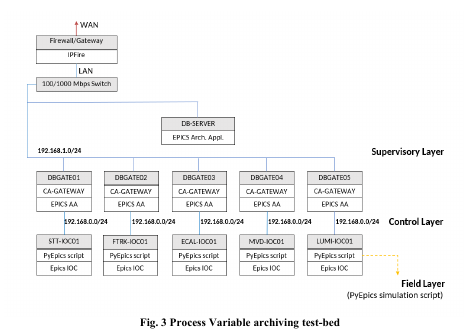
- The setup, configuration and operation of the process variable database server;
- Manage the controls and conditioning of STT read-out electronics and gas system;
- commissioned the gas-mixture and pressure-control system, integrating it with EPICS and utilizing Grafana for real-time monitoring and logging.
- configured PASTTREC via EPICS and developed custom software tools for sniffing, decoding, and calibrating TRB3 data streams.
- individual straw-tube testing to optimize the signal-to-noise ratio and performed spectroscopy evaluations using an Fe-55 radioactive source.

IFIN-HH Team

The team is composed by the following R&D personnel from IFIN-HH Particle Physics Department:
- Dr. Alexandru-Mario BRAGADIREANU - research scientist;
- Dr. Ștefan-Alexandru GHINESCU - research scientist;
- Ovidiu HUTANU - engineer;
- Petre-Constantin BOBOC - research assistant;
- Ionut IONESCU - assistant (computing);
- Ionel NEAGU - engineer;
- Alina MOTORGA - accountant.

Accomplishments

I. Gas system commissioning with EPICS controls


Activity I.1: Developed the gas-mixture and pressure-control system using Bronkhorst pressure and mass-flow meters/controllers; achieved a stable 80%–20% Ar–CO2 mixture with no detectable O2 contamination, verified with a Witt Gas Analyser.

Activity I.2: Integrated the system with an EPICS backend; Control System Studio used for monitoring and diagnostics; gas flow and pressure logged in real time via a Grafana dashboard.

II. PASTTREC configuration via EPICS


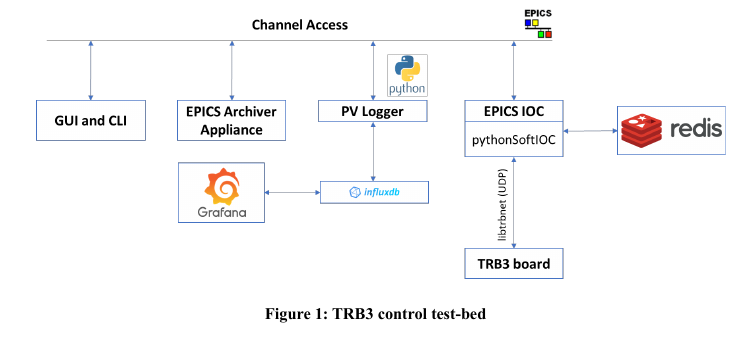
Activity II.1: Configured PASTTREC ASICs via EPICS Channel Access using the pythonSoftIOC module and libtrbnet library; PV values stored in Redis and archived via EPICS Archiver Appliance; critical PVs pushed to InfluxDB and visualised in Grafana.

TRB3 control test-bed

TRB3 control test-bed: EPICS-based control architecture.

Process variable archiving test-bed

Process variable archiving test-bed: network architecture from field layer to supervisory layer.

Activity II.2: Developed a graphical control panel for managing settings of complete PASTTREC boards.

MRCU v.4 operator interface component

MRCU v.4 operator interface component.

III. TRB3 data analysis and PASTTREC baseline calibration


Activity III.1: Developed custom software for sniffing, decoding and saving TRB3 UDP data packets using the Scapy library.

Activity III.2: Implemented and tested two PASTTREC baseline calibration methods: noise scanning via baseline level variation, and an analytical method based on time-over-threshold (ToT) distributions.

IV. HV/LV/Readout partition boards for the 86-straw module


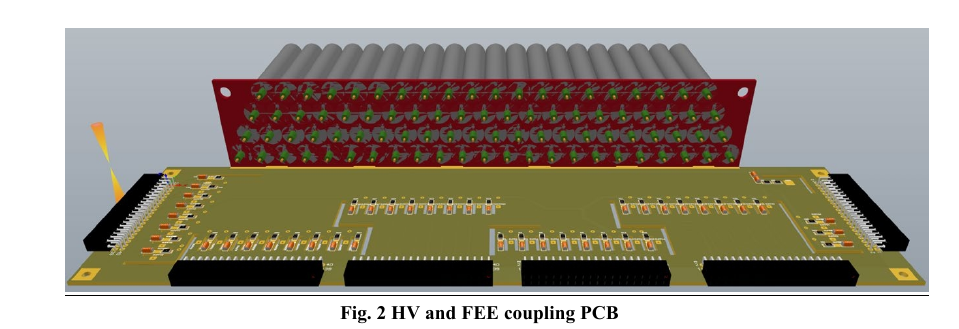
Activity IV.1: Designed and produced in-house the HV and FEE coupling PCB prototype for the 86-straw module.

HV and FEE coupling PCB

HV and FEE coupling PCB for the 86-straw module.

V. Individual straw tubes testing


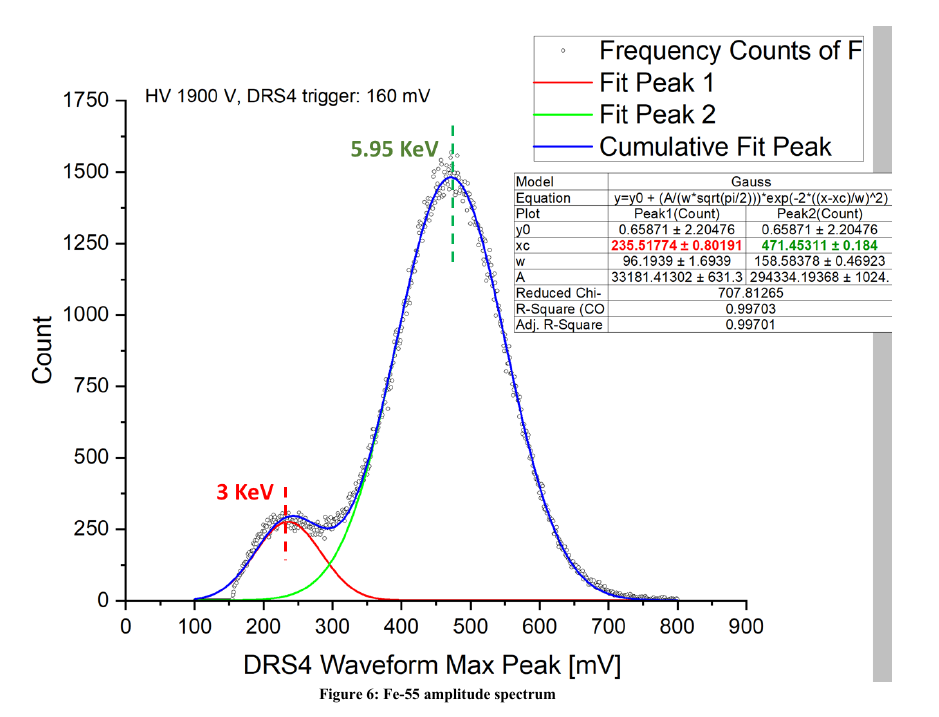
Activity V.1: Optimised the HV bias circuit (R1 = 10 kΩ, C1 = 1 nF, R2 = 1 MΩ, C2 = 500 pF) for best signal-to-noise ratio; performed Fe-55 spectroscopy using an Amptek A250F preamplifier, Cremat CR200 amplifier and DRS4 digitiser (1 GHz, 14-bit); achieved ~33% energy resolution at 5.95 keV. Developed Python software for DRS4 data analysis.

Fe-55 amplitude spectrum

Fe-55 amplitude spectrum measured with the straw tube at HV = 1900 V.

VI. Monte-Carlo simulations in PandaROOT


Activity VI.1: Familiarised with PandaROOT and integrated the 86-straw prototype geometry into the Virtual Monte Carlo (VMC) framework; simulation supports a variable number of straws and charged particles at various incidence angles.

PANDA Collaboration Meeting talks (2020-2025)

List of publications