NA62 objectives

The NA62 experiment aims to measure the very rare kaon decay K+ → π+ν ν at the CERN SPS , to make a decisive test of the Standard Model (SM) by extracting, through a 10% measurement, the Cabibbo–Kobayashi–Maskawa (CKM) parameter |Vtd|.

In order to reach its main goal, NA62 needs to collect about 100 in-flight K+ → π+ν ν events, and to keep the total systematic uncertainty small. Assuming a 10% signal acceptance and a branching ratio of 10-10, at least 1013 K+ decays are required.

To keep the systematic uncertainty small requires a rejection factor, for generic kaon decays, in the order of 1012 and the possibility to measure efficiencies and background suppression factors directly from data.

In addition to the main objective, thanks to its high beam intensity and detector performance, NA62 has a wide physics programme: precise measurements of lepton universality, searches for lepton number (LNV) and lepton flavor number (LFNV) violating processes and searches for exotic particles such as Dark Photons, Heavy Neutral Leptons and axion-like particles.
Project objectives

During the project (2020 - 2026), the Horia Hulubei National Institute of Physics and Nuclear Engineering (IFIN-HH) team has contributed in:
- Upgrade of the Hadron Sampling Calorimeter (HASC), doubling its geometrical acceptance;
- Improve the current HASC time resolution;
- Evaluation of NA62 sensitivity to various dark scalar decay channels;
- Maintain and operate HASC during NA62 Phyics Runs, dry-runs, beam and cosmic rays tests;
- Participate at NA62 shifts during NA62Physics Runs, dry-runs, beam and cosmic rays tests.
- Implementation of various biasing schemes in the NA62 Monte Carlo framework
- Performing the precision measurement of the π0→e+e- branching ratio - Coordinating the NA62 Software and MC Validation working groups

IFIN-HH Team

The team is composed by the following R&D personnel from IFIN-HH Particle Physics Department:
- Dr. Alexandru-Mario BRAGADIREANU - research scientist;
- Ovidiu-Emanuel HUTANU - electronics engineer;
- Stefan-Alexandru GHINESCU - research scientist;
- Petre BOBOC - research assitant;
- Neagu IONEL - technician;
- Alina Motorga - accountant;

Accomplishments

I. Assembly and installation of the second Hadronic Sampling Calorimeter (HASC)


Activity I.1: Production, assembly and testing of HASC FEE and mechanical supports for 18 HASC modules;
Activity I.2: Production, assembly and testing of HASC HV&LV distribution and temperature controller.
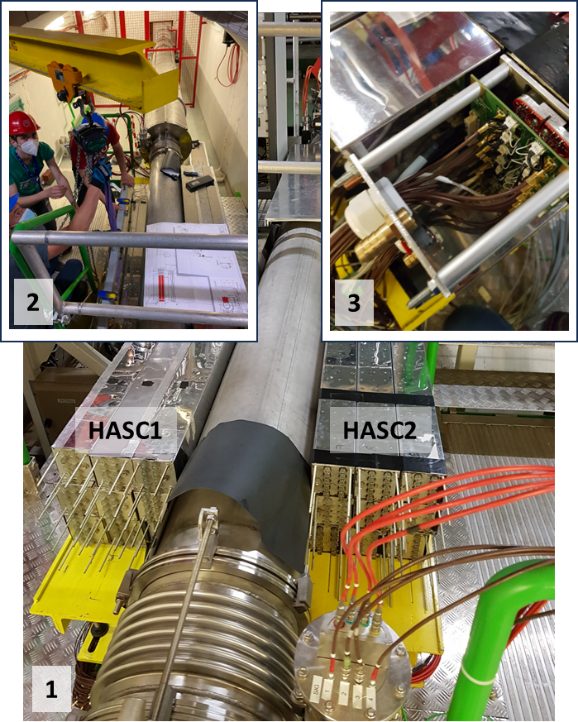
Activity I.3: Installation of the second HASC station.

HASC picture HASC perf

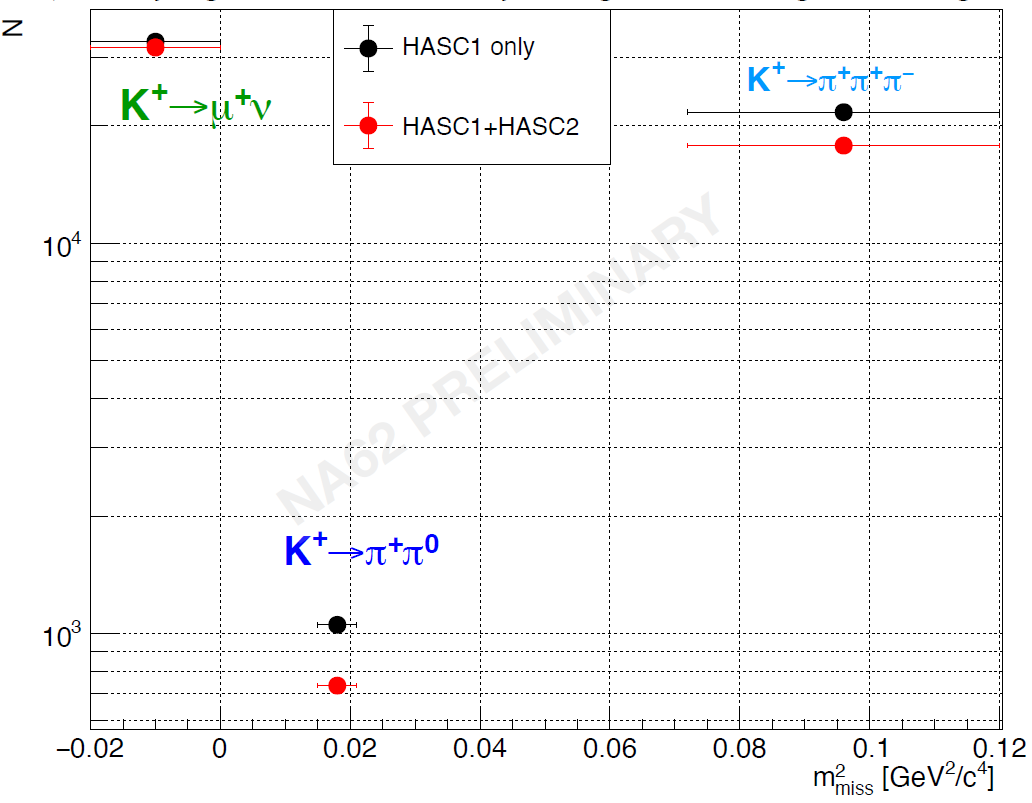
The HASC detector after the installation of the second station (left); The impact of the second station on the various background sources (right).

II. Studies on HASC


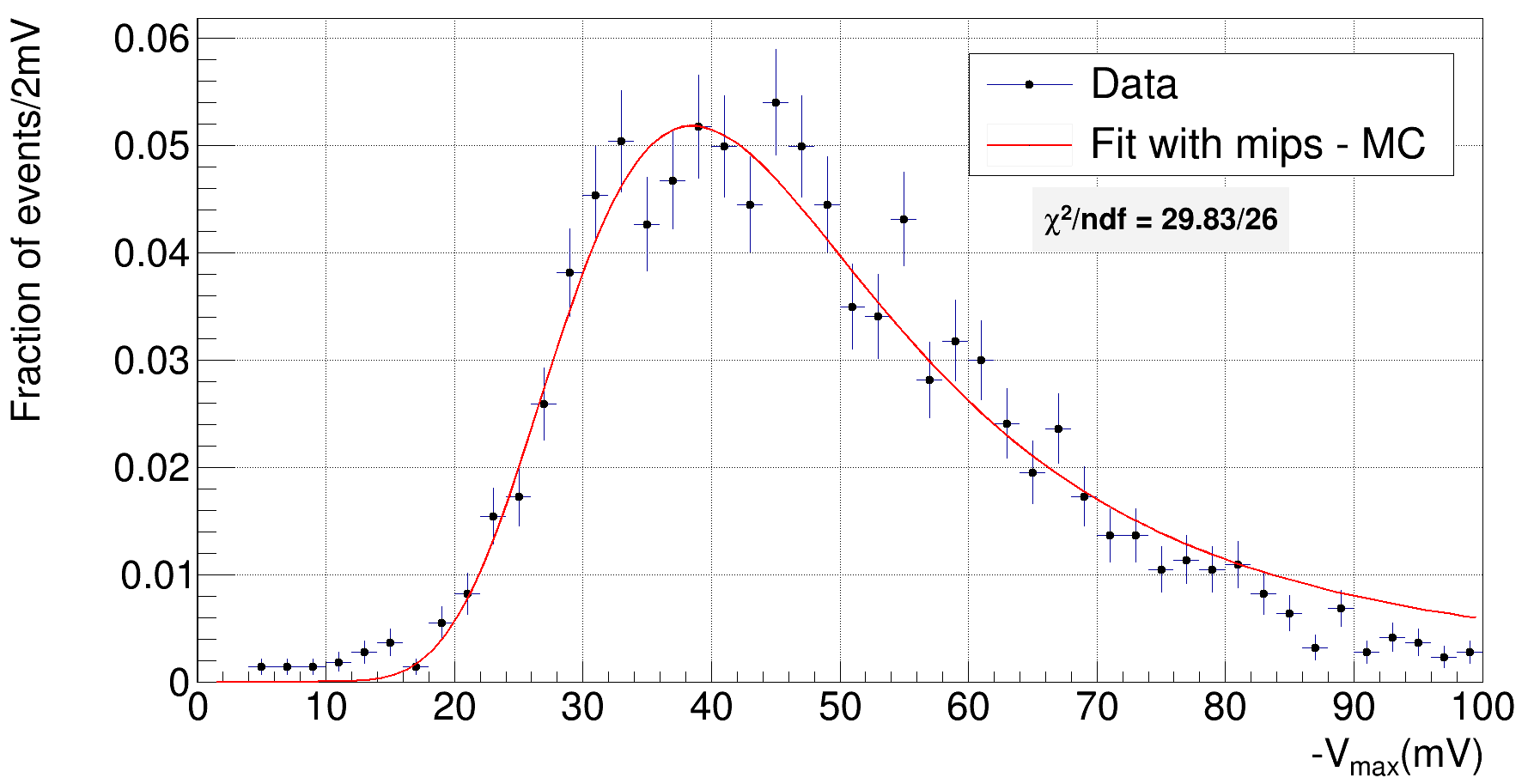
Activity II.1: We elaborated a method for the calibration of the HASC signal. The figure below shows the spectrum of amplitudes of the signals coming from cosmics rays (in blue dots) and the fit (in red) using our model.

HASC calibration

HASC signal calibaration with cosmics

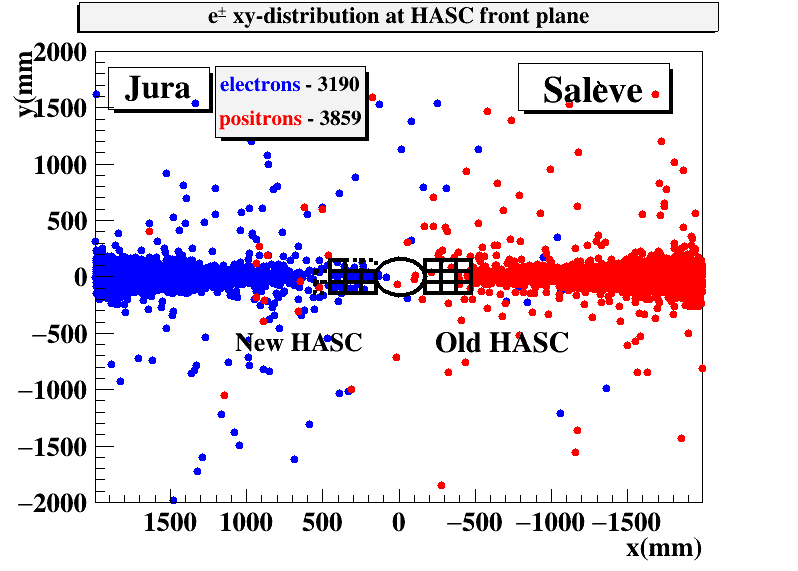
Activity II.2: At the request of the collaboration, we performed an MC simulation in order to determine the optimal placement of the new HASC station. The figure below shows this position to be symetrical to the old station with respect to the beampipe.

New HASC position

Distribution of electrons (blue) and positrons (red) at the front plane of HASC

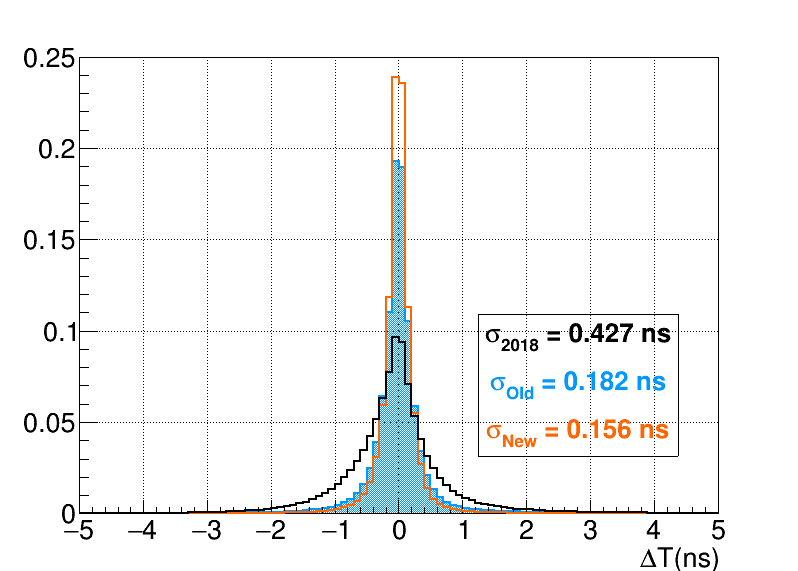
Activity II.3: The performances of the new station and of the cooling system were evaluated by checking the time resolution. The figure below shows the significant improvement in time resolution with respect to 2018 which is due to the lower SiPM operating temperature

HASC timing

HASC time resolution.

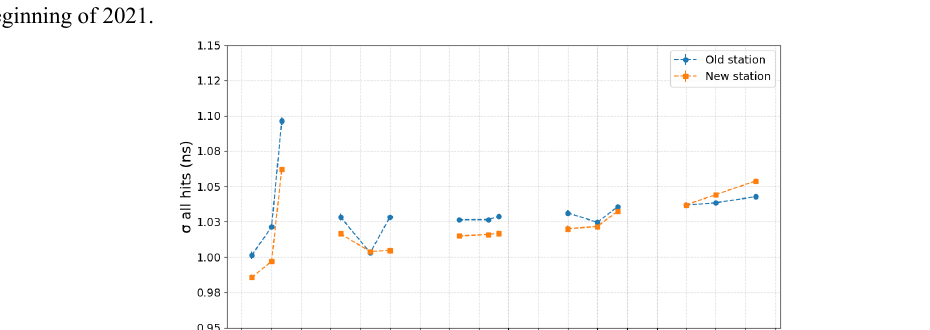
Activity II.4: The HASC was operated continuously throughout the NA62 Physics Runs. The figure below shows the evolution of the hit time resolution for both stations over the 2021–2025 period; it remained within 100 ps of its initial value throughout, confirming stable long-term detector performance.

HASC timing evolution 2021-2025

Evolution of the HASC hit time resolution for the old (blue) and new (orange) stations over the 2021–2025 period.

III. Implementation of variance reduction techniques

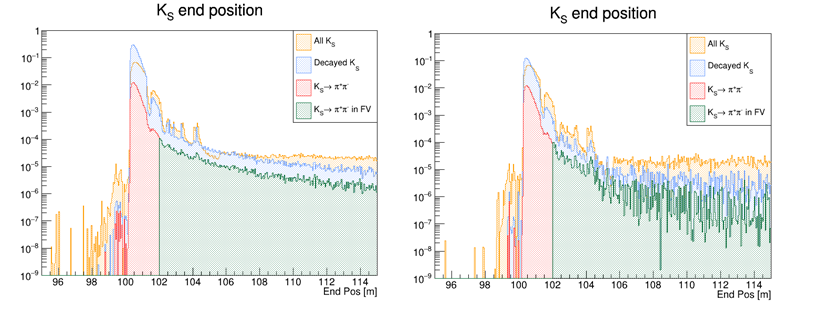
Activity III.1: We have modified the Geant4 K+ inelastic process to always emit a KS of momentum above 20 GeV/c, while accounting for the probability (weight) of this to occur. The figure below shows the enhancement of useful statistics (green) induced by this biasing technique

KS biasing

Decay Z position of KS in biased (left) and analog (right) MC productions

IV. Dark Matter searches

Several dedicated datasets, totalling around of 9.2×10¹⁷, of protons on target was collected by NA62 for the study of dark matter. Ongoing analyses are probing various extensions of the Standard Model and the IFIN-HH team is actively involved in most of them.

Activity IV.1: The generation of an MC sample of the beam background for the collected sample. This activity implies simulating the passage through the experiment of the interaction products of all the 1.4×10¹⁷ primary protons. Several variance reduction techniques have been developed to this end (see the annual summaries).

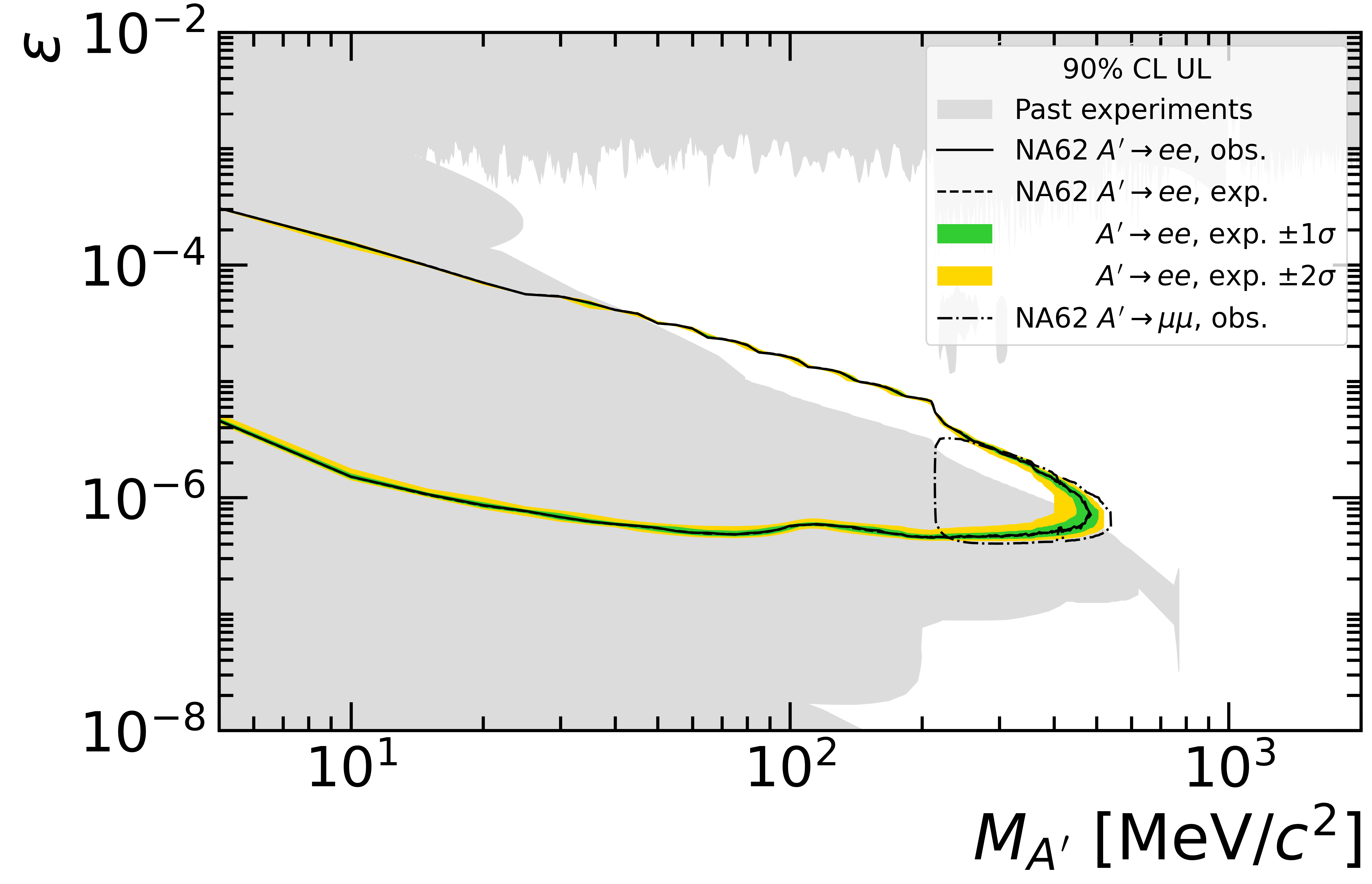
Activity IV.2: The search for dark photons decaying to electron-positron pairs. The figure below shows the region of parameter space excluded as the result of this search

ee exclusion

Exclusion contour in the dark photon parameter space considering only decays to electron-positron pairs

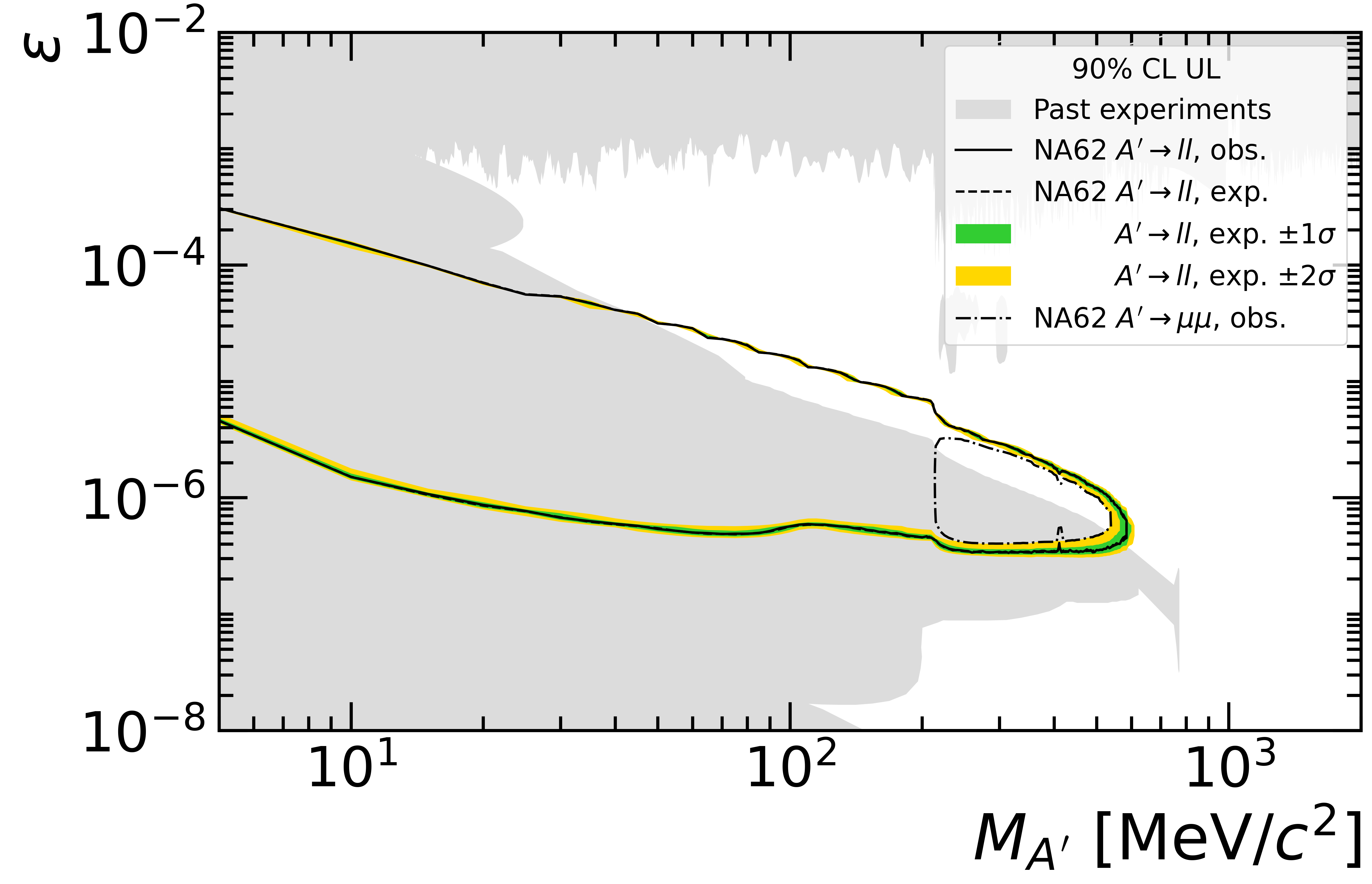
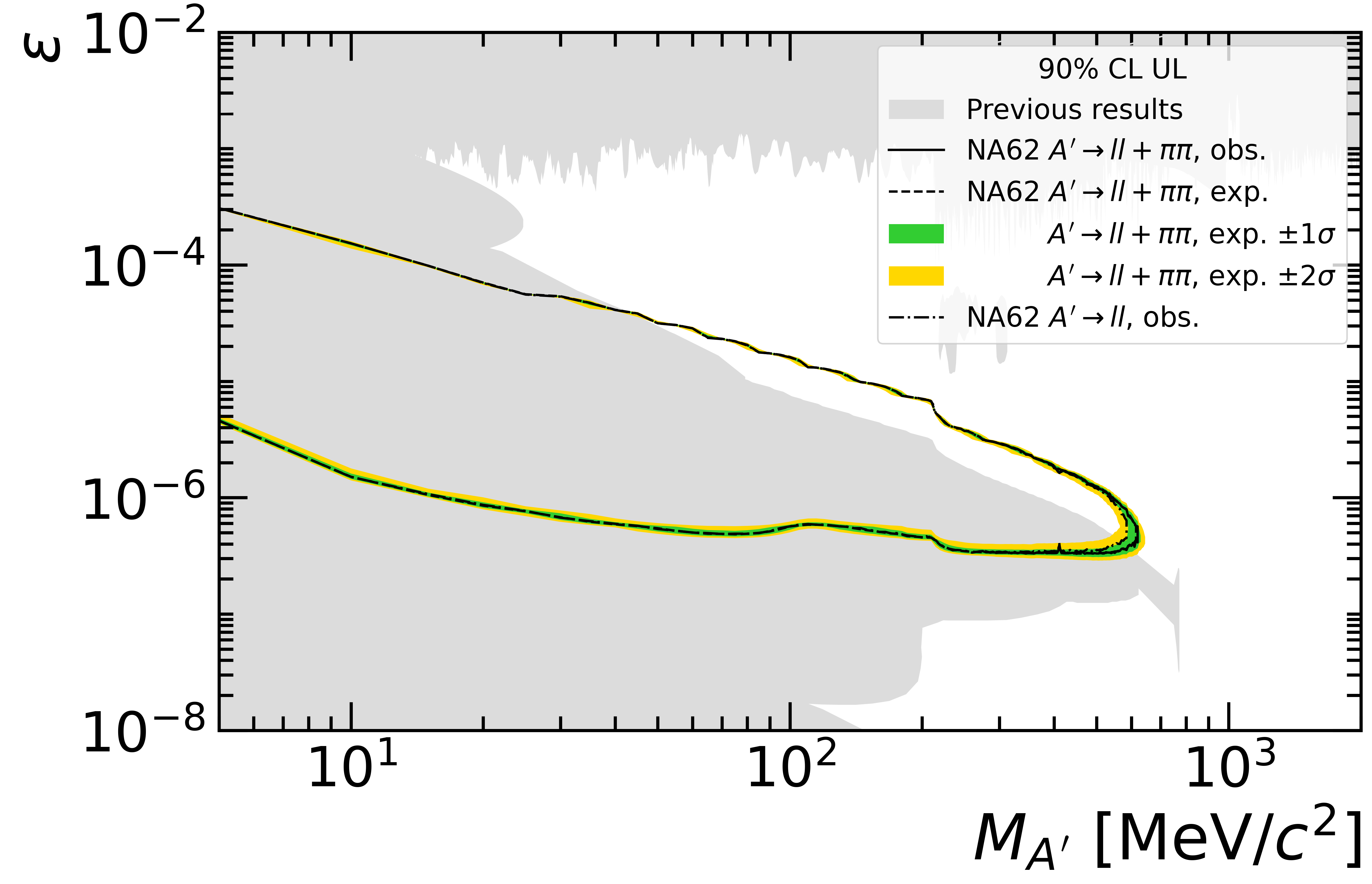
Activity IV.3: The statistical combination of dark photon search results. Dark photons (if they exist) can decay to other final states as well, e.g. muon-antimuon pairs or hadrons. The exclusion regions obtained from the combined results of various final states are shown in the figures below

ll exclusion ll pipi exclusion

Exclusion contour in the dark photon parameter space considering various combinations of final states

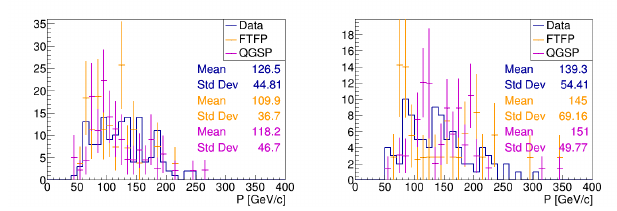
Activity IV.4: Work started on the simulation of charged hadron backgrounds for the beam dump dataset, in the context of the Heavy Neutral Lepton (HNL) search. A biasing algorithm was developed that enhances the hadron halo component production in simulation by a factor of ~4×10⁵. The algorithm was validated against data by comparing the MC and observed yields of KS→π+π- and Λ→pπ- decays, with agreement within a factor of two, as shown in the figure below.

Ks and Lambda momentum distributions

Momentum distributions of KS (left) and Λ (right) at their decay point, comparing data and two MC models (FTFP and QGSP).

V. Precision measurements

In the framework of Chiral Perturbation Theory, the π0→e+e- decay rate measurement provides a tight experimental constraint on calculations. The process has negligible short-distance contributions and is the best-measured pseudo-scalar decay to a pair of leptons. Immediate benefits of the decay rate precision measurement are improved predictions for rates of other pseudo-scalar decays to lepton pairs, such as η→μ+μ- and the long-distance contribution of the KL0→μ+μ- decay. In the latter case the short-distance contribution is a potential source of information on |Vtd|.
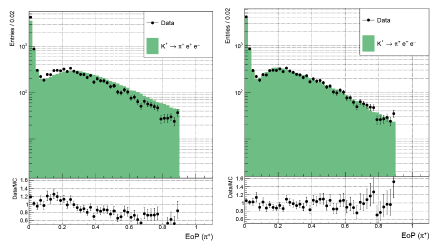
The IFIN-HH team performed the π0→e+e- analysis on the Run 1 dataset using approximately 500 reconstructed K+→π+π0; π0→e+e- decays. A Liquid Krypton (LKr) Energy Emulator was developed, improving the data/MC description of the pion track response (figure below, left) and reducing the total systematic uncertainty to 0.12×10⁻⁸. The resulting preliminary branching ratio is BNA620→e+e-, no‑rad) = (6.26 ± 0.38)×10-8, in good agreement with theoretical predictions; a paper is planned for submission in 2026. Analysis of the Run 2 dataset has also been initiated.
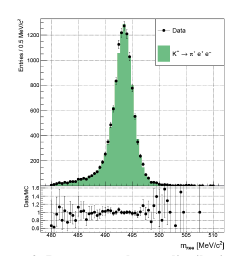
In parallel, the measurement of the K+→π+e+e- branching ratio has been started using Run 2 data. This decay serves as the normalization channel for the π0→e+e- measurement; over 105 candidates have already been observed (figure below, right), enabling an improved world-average determination of both branching ratios.

E/p distributions Reconstructed m_piee

Left: E/p distributions for the pion track with default MC (left panel) and LKr-emulated MC (right panel). Right: Reconstructed mπee for K+→π+e+e- candidates with mee > 140 MeV/c2.

VI. DRD1 – Straw gas gain studies

In the framework of the CERN Detector Research & Development Collaboration (DRD1) devoted to gaseous detector technologies, the IFIN-HH team built a thermal enclosure for the study of straw gas gain as a function of temperature. The setup enables proactive correction of gain variations via automatic high-voltage tuning through the straw control system; the software controls are planned for implementation in 2026.

Publications and talks

Selection of Talks

List of publications